
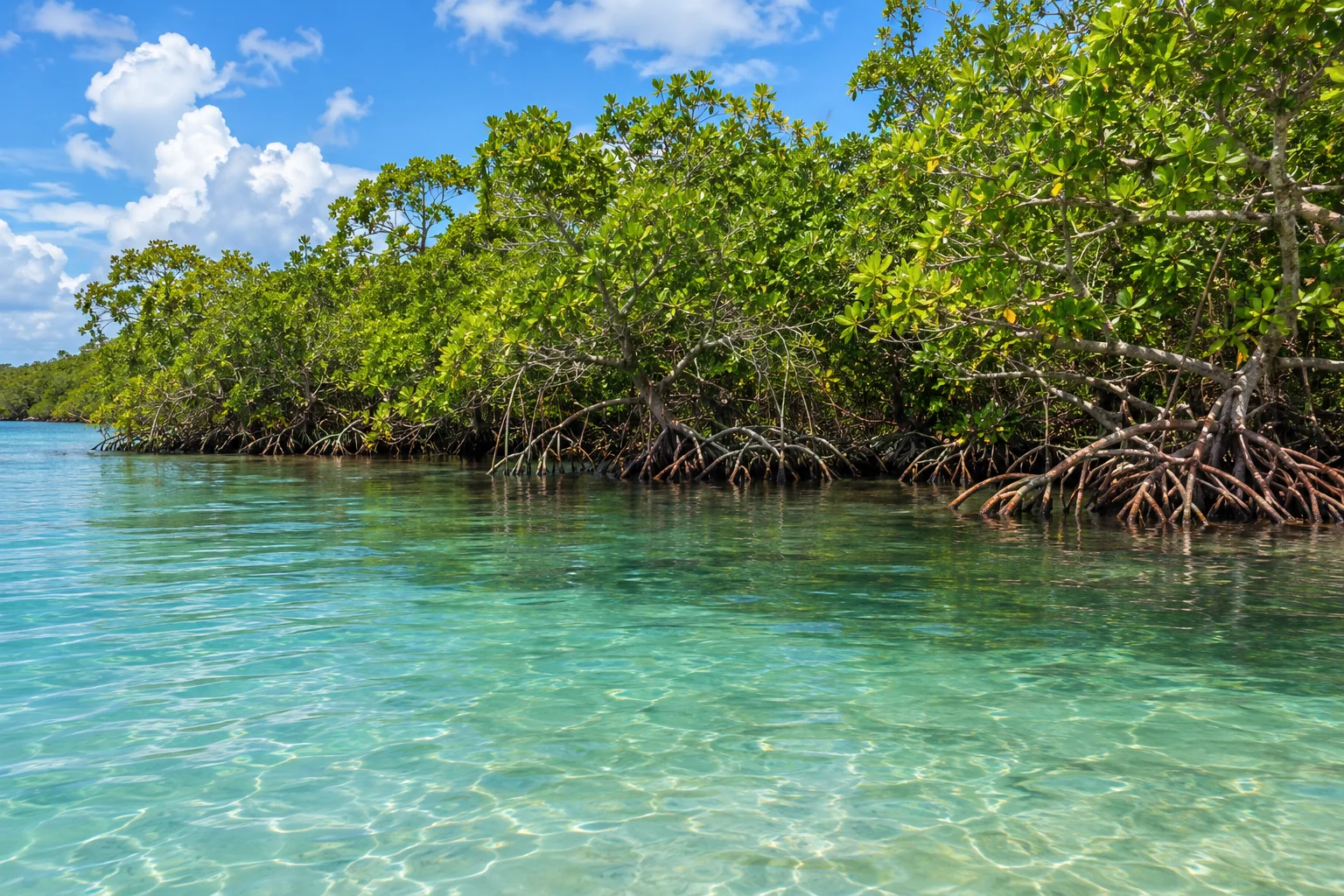
Read the roots as part of the landscape
Mangroves are trees and shrubs adapted to coastal intertidal conditions. Some have conspicuous prop roots; a mangrove shoreline need not resemble the open sand and palms in a beach photograph.
Roots slow water movement and help retain sediment. Their structure provides shelter for fish and other organisms and helps stabilise coasts. These are habitat functions, not a promise that visitors will see particular animals.
Read the tour descriptions without adding a mangrove promise
| Option | Published format | What the route does not establish |
|---|---|---|
| Saona Classic | Shared catamaran day excursion. | No mangrove visit is established by the boat label. |
| Saona Premium | Smaller shared speedboat route with four named stops. | No separate mangrove stop is listed. |
| Private boat | Exclusive boat under an individual proposal. | No automatic access to sensitive habitats. |
Place Saona within the larger protected coast
The Dominican Republic’s description submitted to UNESCO’s Tentative List identifies mangroves among Cotubanamá’s landscapes. The park includes mainland, island and marine areas; that description is not a map of places covered by every Saona excursion.
Keep the scale clear when reading a destination page. A habitat recorded in the park does not establish a landing on Saona, a marked path, permission to enter or a current visitor service at a named site.
Separate a mangrove shore from a beach or water stop
A sandy beach, Palmilla’s Natural Pool and a wooded coastal habitat describe different settings. Swimming in shallow water is not automatically a mangrove visit, and seeing a coastline from a moving boat is not a scheduled interpretation stop.
LoveSaona’s Premium reference route lists the Natural Pool, Toro Beach, Mano Juan and Canto de la Playa. Do not add a mangrove stop to that list. Ask what the proposed route actually includes rather than relying on a generic nature photograph.
Five questions for a nature-focused enquiry
- Which places are actually named in my proposed route?
- Is a nature interest a confirmed activity or only a request?
- Would we observe from the boat or land, if permitted?
- What access conditions and guidance apply to that specific place?
- What are the complete quote and change arrangements?
Observe without turning habitat into a shortcut
If your confirmed route offers a view of coastal vegetation, observe from the permitted position and follow crew and park instructions. Do not request a passage through roots, an unconfirmed landing or wildlife handling for a photograph.
Leave branches, roots and animals undisturbed, keep waste with you and avoid feeding wildlife. These are visitor-care recommendations; current access rules must be confirmed separately. A quiet-looking stretch of water does not establish permission to enter.
Use your nature interest to choose a realistic day
Compare the published stops and tell the team what interests you. A route with village and beach time can be worthwhile without a specialist habitat visit. A private boat still needs a feasible, permitted itinerary; exclusivity does not grant unrestricted access.
Send your date, hotel and party details through the form. Ask whether any proposed nature observation is actually available, where it takes place and what it includes. No mangrove excursion, guide service or wildlife encounter is confirmed by this article.
Questions about mangroves and Saona tours
Does Premium include a mangrove stop?
The published route names Natural Pool, Toro Beach, Mano Juan and Canto de la Playa. It does not list a separate mangrove visit.
Does a national park tour visit every habitat?
No. The park is a larger protected setting; each excursion follows a particular route.
Will I see birds, fish or other wildlife?
A habitat description does not guarantee sightings. No particular animal encounter is promised here.
Can a private boat enter any mangrove area?
Do not assume so. The actual route, access and operating arrangements need confirmation; private use does not create unrestricted access.
Editorial scope
Checked 4 November 2026. General mangrove ecology follows NOAA; park context follows the Dominican submission published on UNESCO’s Tentative List, which is not World Heritage inscription. Tour details follow LoveSaona’s published pages. No current habitat access, exact observation site, specialist service or departure-specific operation is verified here.